Welcome to the Fair MusE
Dashboard

A demonstrator

Welcome to the
Fair MusE
Dashboard

A demonstrator

The Idea

Can Fairness be Expressed in Numbers?

The Fair MusE EU research project aimed to analyse fairness in the music eco-system from three perspectives: A legal, an economic and a consumption-oriented one.

In this music data dashboard, we present selected quantifiable findings that highlight patterns in music streaming, opinions on fairness and developments of fairness concepts in EU legal texts.

Unfortunately for our research into fairness, it has not been possible to obtain any detailed information on artist remuneration. Fairness in terms of music creators' financial conditions can thus not be examined with data that is publicly available.

The Idea

Can Fairness be Expressed in Numbers?

The Fair MusE EU research project aimed to analyse fairness in the music eco-system from three perspectives: A legal, an economic and a consumption-oriented one.

In this music data dashboard, we present selected quantifiable findings that highlight patterns in music streaming, opinions on fairness and developments of fairness concepts in EU legal texts.

Unfortunately, it has not been possible to obtain any detailed information on artist remuneration. Fairness in terms of creators' financial conditions can thus not be examined with publicly available data.

Dashboard Overview

Research Approach

This website demonstrates how data from users of music streaming services, surveys, and interviews can help elucidate questions of fairness and diversity.

We developed a method for 'data donation': Users could share their personal music data with us via portal.fairmuse.eu. The data helped us to research fairness of music streaming services. By analysing the listening history for 173 users and comparing it with airplay data from 73 radio channels, we can identify patterns in music consumption over more than a decade.

We conducted a survey to examine music professionals' opinions on algorithmic recommendations, remuneration and fairness.

To find out how legislators have dealt with the fairness question over time we analysed 121 legal documents for key terms.

We conducted 36 in-depth interviews with users of streaming services. We found that although users are concerned about the lack of fairness, they feel inhibited from changing the situation. Additionally, the lack of data portability prevents free and fair competition among streaming platforms.

Finally, we present an overview of statistical sources on music data. The scarcity of data sources, their fragmented coverage of the EU countries and the inaccessibility of detailed data calls for the European Music Observatory.

Dashboard Overview

Research Approach

This website demonstrates how data from users of music streaming services, surveys, and interviews can help elucidate questions of fairness and diversity.

We developed a method for 'data donation': Users could share their personal music data with us via portal.fairmuse.eu . By analysing the listening history for 173 users and comparing it with airplay data from 73 radio channels, we identify patterns in music consumption over more than a decade.

We conducted a survey to examine music professionals' opinions on algorithmic recommendations, remuneration and fairness.

To find out how legislators have dealt with the fairness question over time we analysed 121 legal documents for key terms.

We conducted 36 in-depth interviews with users. We found that although users are concerned about fairness, they feel inhibited from changing the situation.

Finally, we present an overview of statistical sources. The scarcity and fragmentation of data calls for the European Music Observatory.

Data and Donations

Data and Donations

Donor Listening History

Donor Listening History Plot

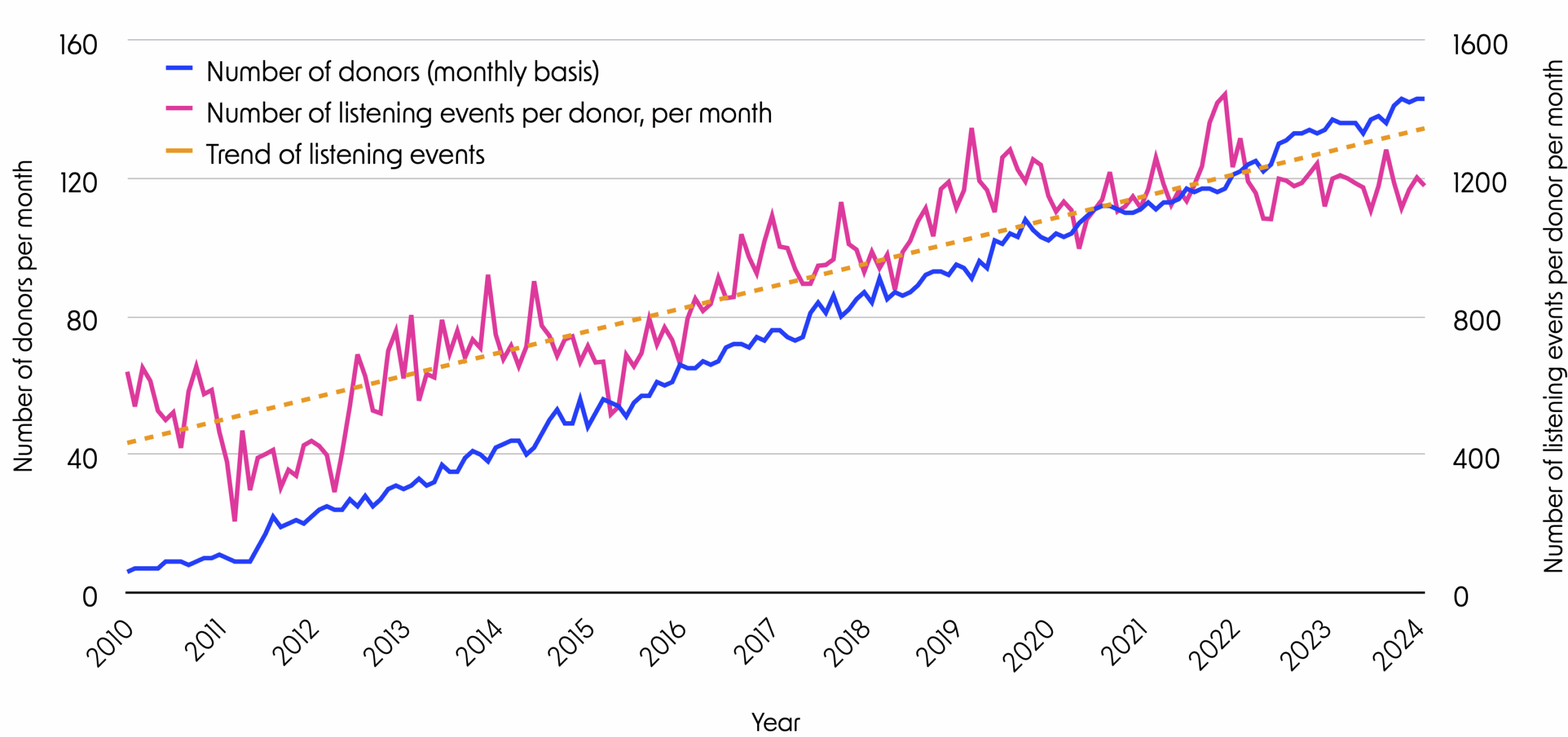
Streaming Attracts More People Over Time and Their Listening Increases

Since 2010, more and more donors have started to use streaming services. This is shown in the blue line. As only active listening is registered, we see some fluctuations; when a donor has no listening sessions within a month, it results in a dip in the blue line.

The pink line shows the average number of tracks listened to per month per user. It increases steadily, indicating that donors who adopted streaming services tended to listen more frequently over time. The orange trend-line summarizes our donors' growing use of the streaming services.

Details

The plot shows donation data until March 18, 2024.
Donor Listening History

Streaming Attracts More People Over Time and Their Listening Increases

Donor Listening History Plot

Since 2010 more and more donors have started to use streaming services. This is shown in the blue line. As only active listening is registered, we see some fluctuations. When a donor has no listening sessions within a month, we see a dip in the blue line.

The pink line shows the average number of tracks listened to per month per user. It increases steadily, indicating that donors who adopted streaming services tended to listen more frequently over time. The orange trend-line summarises our donors' growing use of the streaming services.

Details

The plot shows donation data until March 18, 2024.

Data Download Wait-Time

Declining Wait Time Plot

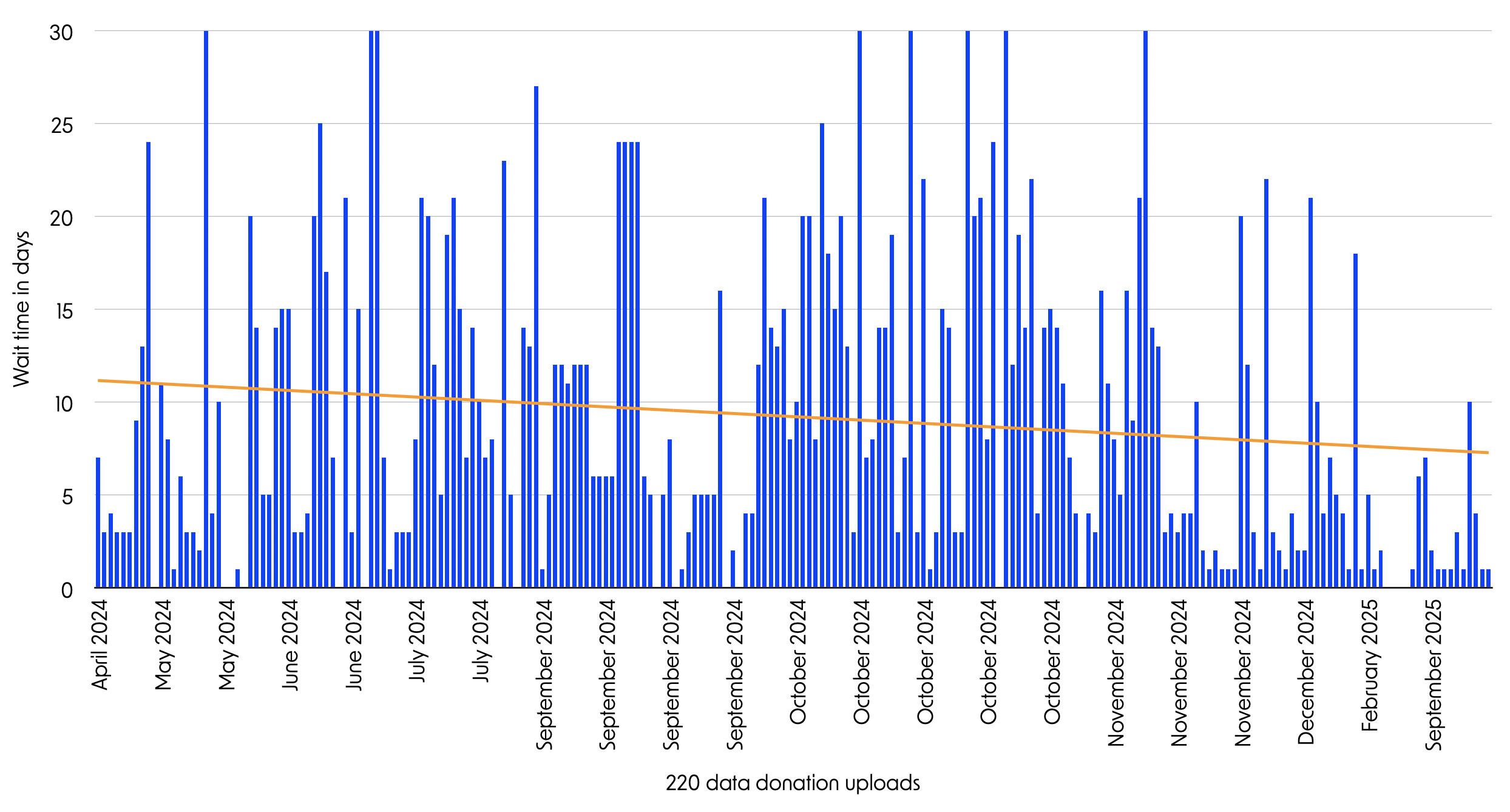
Spotify Speeding Up!

The user data donation process was slowed down by the streaming services. Before donating their streaming history data, our donors had to request data from their streaming platform and wait.

While Apple and Google (YouTube) offered the data within a few days, Spotify needed up to 30 days to deliver. In this plot, we see donors' self-reported waiting time.

Most donations came from Spotify users. Over the data collection period, Spotify's announced 30-day waiting time has declined, as shown with the orange trend-line. It suggests that Spotify has become more efficient in providing requested data.

Details

The graph represents self-reported data from donors on how long they had to wait before they received their streaming history data after requesting it. The time varied between 1–30 days and was quite irregular; however, there was an overall decline in waiting time. Especially around the end of 2024 and throughout 2025, the majority of the requests took 5 days or less to process.
Data Download Wait-Time

Spotify Speeding Up!

Declining Wait Time Plot

The user data donation process was slowed down by the streaming services. Before donating their streaming history data, our donors had to request data from their streaming platform and wait.

While Apple and Google (YouTube) offered the data within a few days, Spotify needed up to 30 days to deliver. In this plot, we see donors' self-reported waiting time.

Most donations came from Spotify users. Over the data collection period, Spotify's announced 30-day waiting time has declined, as shown with the orange trend-line. It suggests that Spotify has become more efficient in providing requested data.

Details

The graph represents self-reported data from donors on how long they had to wait before they received their streaming history data after requesting it. The time varied between 1–30 days and was quite irregular; however, there was an overall decline in waiting time. Especially around the end of 2024 and throughout 2025, the majority of the requests took 5 days or less to process.

Donors: Platforms

Which Platforms Do Our Donors Use?

The vast majority of our donors (87%) use Spotify as their main streaming service. This echoes Spotify's market share dominance (~32%). Apple Music and YouTube Music are under-represented in our dataset. Hover over each slice to see how many listening events we received per platform.

Details

Hovering on each slice shows additional data on the number of listening events counted. Around 11% of our donors use Apple Music, but they do not listen as much as Spotify donors: only 2.4% of the listening is from Apple donors.

For reference, Apple Music’s market share is ~40% of Spotify’s market share. Less than 2% of our data donations use YouTube Music, and they only account for 0.1% of all listening events. For reference, YouTube Music is ~30% of Spotify’s market share. Note: Donors could donate data from more than one platform.

Donors: Platforms

Which Platforms Do Our Donors Use?

The vast majority of our donors (87%) use Spotify as their main streaming service. This echoes Spotify's market share dominance (~32%). Apple Music and YouTube Music are under-represented in our dataset. Hover over each slice to see how many listening events we received per platform.

Details

Hovering on each slice shows additional data on the number of listening events counted. Around 11% of our donors use Apple Music, but they do not listen as much as Spotify donors: only 2.4% of the listening is from Apple donors.

For reference, Apple Music’s market share is ~40% of Spotify’s market share. Less than 2% of our data donations use YouTube Music, and they only account for 0.1% of all listening events. For reference, YouTube Music is ~30% of Spotify’s market share. Note: Donors could donate data from more than one platform.

Donors: Countries

Where Were Our Donors From?

Despite our efforts to focus on recruiting donors from all eight countries in the Fair MusE consortium (Austria, Belgium, Denmark, Estonia, France, Greece, Italy, and Portugal), we received donations in various numbers from 27 European countries.

Denmark and France, home countries to the data science researchers, are particularly well represented as our personal networks turned out to perform best in terms of recruitment success rate. On average, for every 100 persons contacted, we obtained one donation.

Details

The figure shows the distribution of donors by their country of residence. Each slice of the donut plot shows the number of donors per country as a percentage of the total 159 donations.

Approximately 50% of the donors come from Denmark, France, and Portugal. Around 30% of the donors come from Belgium, Italy, Germany, and Spain. All countries with three donors or less are grouped in the category "Other (<2%)". Donors without country information (~4%) are grouped as "N/A".

Donors: Countries

Where Were Our Donors From?

Despite our efforts to focus on recruiting donors from all eight countries in the Fair MusE consortium (Austria, Belgium, Denmark, Estonia, France, Greece, Italy and Portugal), we received donations in various numbers from 27 European countries.

Denmark and France, home countries to the data science researchers, are particularly well represented as our personal networks turned out to perform best in terms of recruitment success rate. On average, for every 100 persons contacted, we obtained one donation.

Details

The figure shows the distribution of donors by their country of residence. Each slice of the donut plot shows number of donors per country, as a percentage of the total 159 donations.


Approximately 50% of the donors come from Denmark, France, and Portugal. Around 30% of the donors come from Belgium, Italy, Germany, and Spain. All countries with 3 donors or less are grouped in the category “other (<2%)”. Donors without country information (~4%) are grouped as “N/A”.

Donors: Age

Young Users

Our donors are mostly young, but they have an impressive listening intensity. In total, we analyze more than 13.7 million listening events over 15 years. The number of listening events for each user can be seen on the y-axis. On the x-axis, we see the age of our donors. With 173 donations, we don't present a very large dataset. We recommend that policy-making be based on a larger dataset.

Details

Distribution of listening events by age group. The x-axis shows each age group category. Donors without age group data are marked as "N/A". The y-axis shows the listening events count per donor in a logarithmic scale (this scale allows to visualize data with a very large spread).

Each dot represents one user, color-coded by gender for each age group: female in coral, male in cadet blue, and other in light brown. Most donors in our dataset (represented by a cluster of dots in each age group) register between 20,000 and 200,000 listening events approximately. Donors over the age of 60, as a group, show the smallest listening event counts (less than 20,000).

Donors: Age

Young Users

Our donors are mostly young, but they have an impressive listening intensity. In total, we analyze more than 13.7 million listening events over 15 years.

The number of listening events for each user can be seen on the y-axis. On the x-axis, we see the age of our donors. With 173 donations, we don't present a very large dataset. We recommend that policy-making be based on a larger dataset.

Details

Distribution of listening events by age group. The x-axis shows each age group category. Donors without age group data are marked as “N/A”. The y-axis shows the listening events count per donor in a logarithmic scale (this scale allows to visualize data with a very large spread). Each dot represents one user, color coded by gender for each age group: female in coral, male in cadet blue, other in light brown. Most donors in our dataset (represented by a cluster of dots in each age group) register between 20,000 and 200 000 listening events approximately. Donors over the age of 60, as a group, show the smallest listening event counts (less than 20,000).

Selected Radio Channels

Selected Radio Channels Plot

Radio Channels as Benchmark

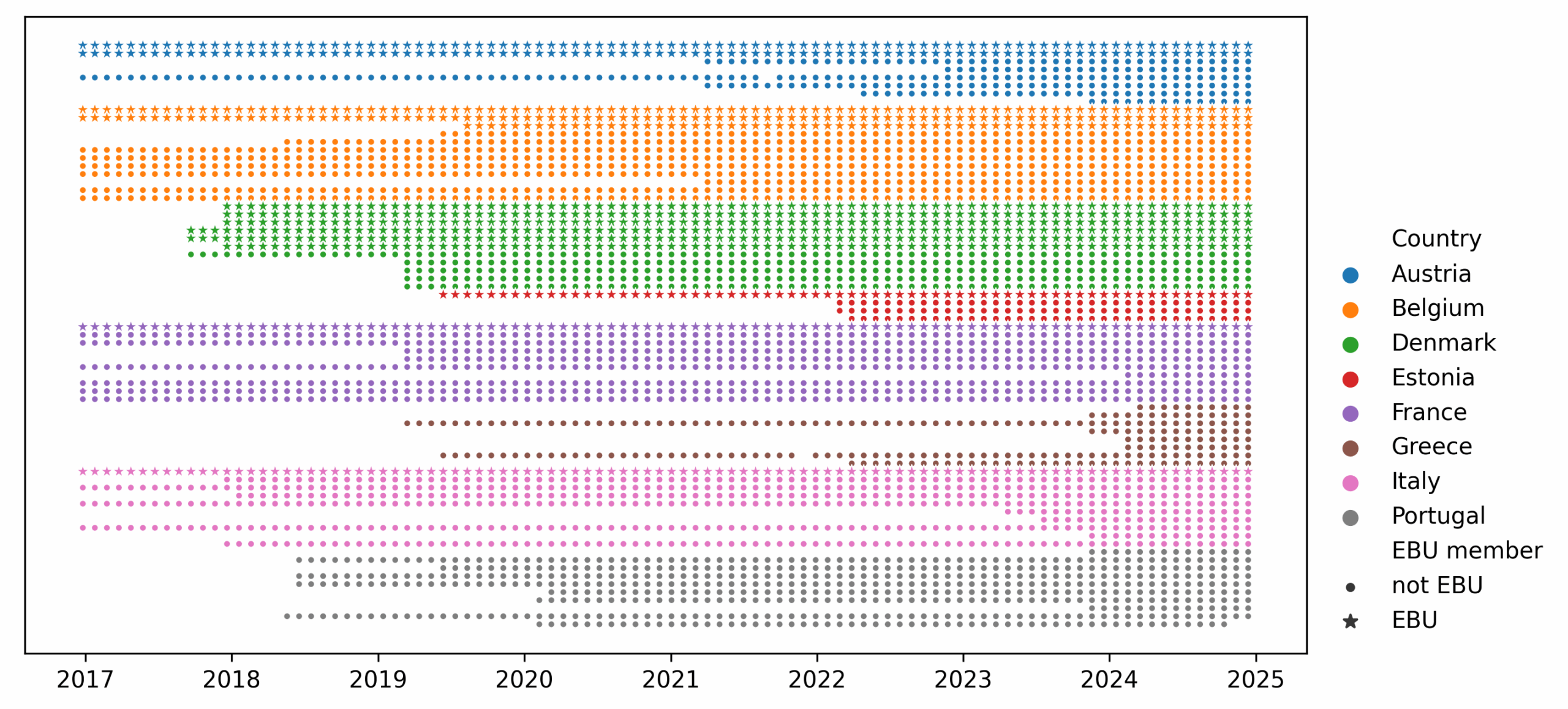
Radio is a curated precursor to algorithmic streaming of music. As such, it is interesting to analyze similarities and differences between the two media. We selected 14 public service radio channels ("EBU") and 59 commercial radio channels from the eight Fair MusE consortium countries to analyze playlist diversity over time.

Each row on the graph represents a radio station, and the range of dots represents its broadcasting timeline. Contrary to commercial radios, public service channels typically have obligations to present diverse music. Our dataset comprises more than 50.9 million airplays.

Details

Some radios have been operating for over 8 years, while others began much more recently. All radios were broadcasting during this project; only one selected Portuguese channel ceased to operate before 2025. One dot is one month of broadcasting; if the symbol is a star, this means that the radio is an EBU member. EBU stands for European Broadcasting Union, an alliance of public service media organisations. Some public service channels have special obligations to promote diversity, e.g., in music.
Selected Radio Channels

Radio Channels as Benchmark

Selected Radio Channels Plot

Radio is a curated precursor to algorithmic streaming of music. As such, it is interesting to analyze similarities and differences between the two media. We selected 14 public service radio channels ("EBU") and 59 commercial radio channels from the eight Fair MusE consortium countries to analyze playlist diversity over time.

Each row on the graph represents a radio station, and the range of dots represents its broadcasting timeline. Contrary to commercial radios, public service channels typically have obligations to present diverse music. Our dataset comprises more than 50.9 million airplays.

Details

Some radios have been operating for over 8 years, while others began much more recently. All radios were broadcasting during this project; only one selected Portuguese channel ceased to operate before 2025. One dot is one month of broadcasting; if the symbol is a star, this means that the radio is an EBU member. EBU stands for European Broadcasting Union, an alliance of public service media organisations. Some public service channels have special obligations to promote diversity, e.g., in music.

Fairness in Numbers

Fairness in Numbers

Limitations of Visualisations

Analysing fairness through data is a challenging task. Data can be collected, processed, combined and visualised in many ways. Here we present our first attempts to quantify and visualise aspects of music consumption and broadcasting that could be relevant for the discussion of fairness and diversity in the music eco-system.

Our dataset is small and not representative. By no means do these calculations constitute a final statement on the fairness of streaming services. Instead, our intention is to demonstrate some possibilities to visualise trends and tendencies.

The dashboard also demonstrates — indirectly — the inaccessibility of data. Future analyses should also include internal data from streaming services.

Details

Despite us exploring many different aspects of the user donations, it was not possible for us to fully determine the effect of the algorithm on donors' listening behaviour. This indicates an overall lack of transparency. Without internal data from streaming services, little can be concluded on the effect of recommendation algorithms.

Limitations of Visualisations

Analysing fairness through data is a challenging task. Data can be collected, processed, combined and visualised in many ways. Here we present our first attempts to quantify and visualise aspects of music consumption and broadcasting that could be relevant for the discussion of fairness and diversity in the music eco-system.

Our dataset is small and not representative. By no means do these calculations constitute a final statement on the fairness of streaming services. Instead, our intention is to demonstrate some possibilities to visualise trends and tendencies.

The dashboard also demonstrates — indirectly — the inaccessibility of data. Future analyses should also include internal data from streaming services.

Details

Despite us exploring many different aspects of the user donations, it was not possible for us to fully determine the effect of the algorithm on donors' listening behaviour. This indicates an overall lack of transparency. Without internal data from streaming services, little can be concluded on the effect of recommendation algorithms.

Radio vs. Streaming Track Diversity

Streaming Users Have a More Diverse Listening

To the left, we compare 73 radio channels with each other: To what extent do they play the same tracks? Purple (-3) means very little overlap. Yellow (0) means a complete overlap. The diagonal yellow line emerges when the radio channel is compared with itself.

To the right, we compare 173 donors with each other. We see that donors are much more diverse in terms of tracks listened to than the curated playlists of the radio channels.

Is the higher diversity among donors resulting from algorithmic recommendations or active choice? Unfortunately, we don't know whether a streamed track has been started from an algorithmic recommendation or by a manual choice, but in the plot "Eleven Reasons to Start," we see that the share of autoplay ("trackdone") has grown over the years.

Details

The top 200 songs were taken for each radio/donor due to the comparison being computationally demanding. We have amplified the numbers using a logarithmic scale and the F1 metric. 0 (yellow) means complete overlap, while -3 (purple) means no overlap. The yellow diagonal line results from each donor being compared with themselves. The data used is from April 2024.

Radio vs. Streaming Track Diversity

Streaming Users Have a More Diverse Listening

In the first figure, we compare 73 radio channels with each other: To what extent do they play the same tracks? Purple (-3) means very little overlap. Yellow (0) means a complete overlap. The diagonal yellow line emerges when the radio channel is compared with itself.

In the second figure, we compare 173 donors with each other. We see that donors are much more diverse in terms of tracks listened to than the curated playlists of the radio channels.

Is the higher diversity among donors resulting from algorithmic recommendations or active choice? Unfortunately, we don't know whether a streamed track has been started from an algorithmic recommendation or by a manual choice, but in the plot "Eleven Reasons to Start," we see that the share of autoplay ("trackdone") has grown over the years.

Details

The top 200 songs were taken for each radio/donor due to the comparison being computationally demanding. We have amplified the numbers using a logarithmic scale and the F1 metric. 0 (yellow) means complete overlap, while -3 (purple) means no overlap. The yellow diagonal line results from each donor being compared with themselves. The data used is from April 2024.

Direct Comparison of Donors and Radios

Streamers Are Not Like Radio Channels

In this heatmap, we directly compare radios and donors. Radio channels' curation—the selection of tracks—is very different from donors' listening. The data used is from April 2024, using the top-200 tracks.

There is very little overlap between radio channels and our donors in terms of tracks. We can thus conclude that streaming and radio are very different media in terms of the music played.

Details

The radio channels are placed on the x-axis and the donors on the y-axis. Each intersection shows the similarity of one radio channel's airplay history and one donor's listening history, with yellow indicating higher similarity. Again, we use a logarithmic scale to highlight the few similarities, which are calculated using the F1 metric.

Direct Comparison of Donors and Radios

Streamers Are Not Like Radio Channels

In this heatmap, we directly compare radios and donors. Radio channels' curation—the selection of tracks—is very different from donors' listening. The data used is from April 2024, using the top-200 tracks.

There is very little overlap between radio channels and our donors in terms of tracks. We can thus conclude that streaming and radio are very different media in terms of the music played.

Details

The radio channels are placed on the x-axis and the donors on the y-axis. Each intersection shows the similarity of one radio channel's airplay history and one donor's listening history, with yellow indicating higher similarity. Again, we use a logarithmic scale to highlight the few similarities, which are calculated using the F1 metric.

Where Do the Artists Come From?

Artist Country Distribution Plot

Artists From the US and the UK Dominate

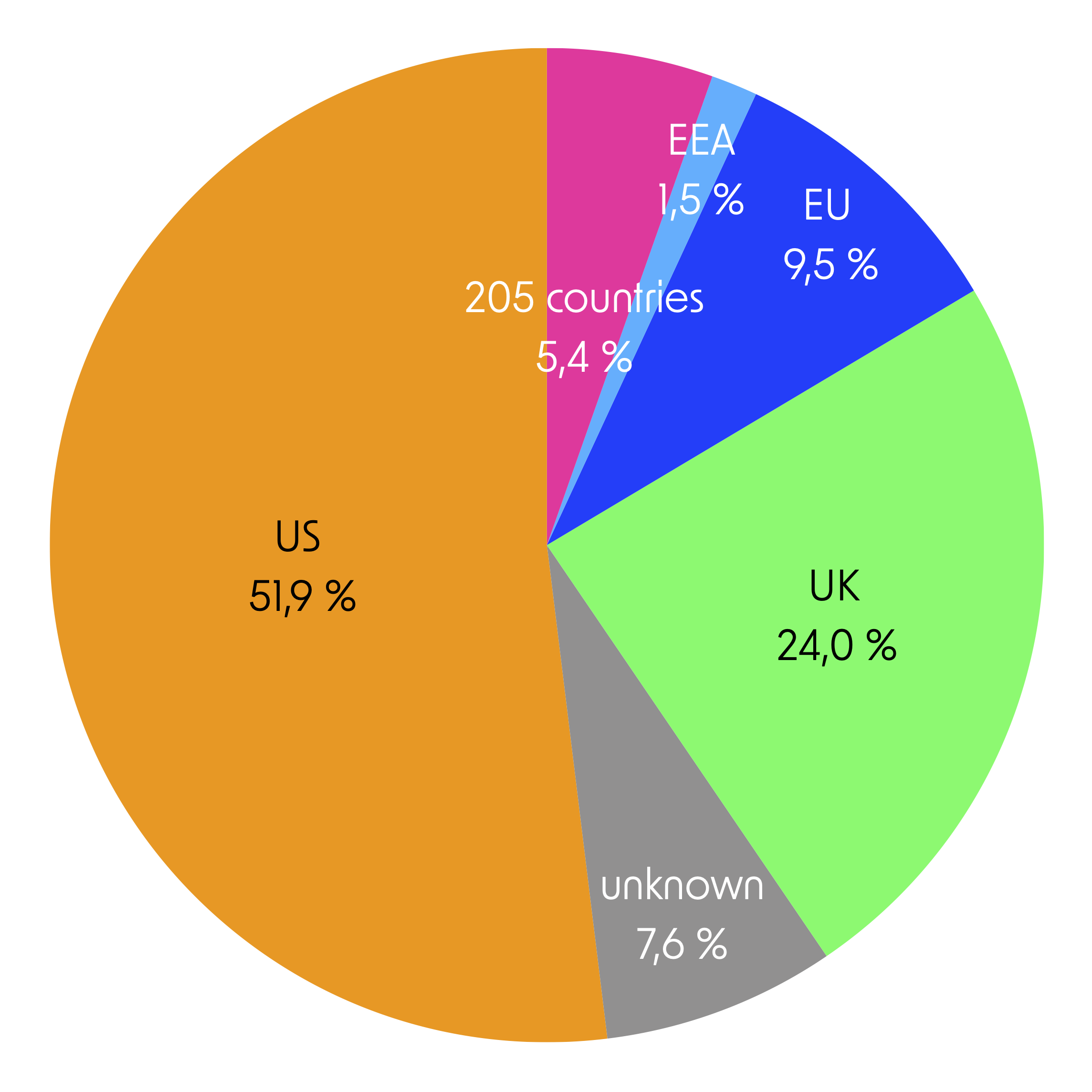
More than half of our donors' listening is created by artists from the US. The UK holds a prominent second position. Only 10% of the music has been created by artists in the EU. Our donors, however, have an interest in artists from a very wide range of other countries—205 to be precise. Finally, for 8% of the listening events, our data source provides no information on the artist's country.

If we look at independent labels organized in the umbrella organization "IMPALA", the pattern of country dominance (here in terms of label country) is mirrored, but with interesting exceptions (number of listening events): UK: 8,263, Denmark: 6,295, Netherlands: 3,394, USA: 2,683, Sweden: 1,476, Germany: 1,443, Georgia: 1,335, Italy: 1,053, Finland: 920, Norway: 568, Spain: 229, Australia: 161, Austria: 137, France: 90, Hungary: 47, Greece: 38, and Belgium: 21 listening events.

Details

Determining an artist's country is difficult. We use an external data source: MusicBrainz. An artist's country is defined by MusicBrainz as "the area with which an artist is primarily identified with. It is often, but not always, its birth/formation country." (https://musicbrainz.org/doc/Artist). The principles or processes for assigning "areas" to artists are not available to us; they are simply provided in the streaming data. The calculation is thus our best effort based on the available data.
Where Do the Artists Come From?

Artists From the US and the UK Dominate

Artist Country Distribution Plot

More than half of our donors' listening is created by artists from the US. The UK holds a prominent second position. Only 10% of the music has been created by artists in the EU. Our donors, however, have an interest in artists from a very wide range of other countries—205 to be precise. Finally, for 8% of the listening events, our data source provides no information on the artist's country.

If we look at independent labels organized in the umbrella organization "IMPALA", the pattern of country dominance (here in terms of label country) is mirrored, but with interesting exceptions (number of listening events): UK: 8,263, Denmark: 6,295, Netherlands: 3,394, USA: 2,683, Sweden: 1,476, Germany: 1,443, Georgia: 1,335, Italy: 1,053, Finland: 920, Norway: 568, Spain: 229, Australia: 161, Austria: 137, France: 90, Hungary: 47, Greece: 38, and Belgium: 21 listening events.

Details

Determining an artist's country is difficult. We use an external data source: MusicBrainz. An artist's country is defined by MusicBrainz as "the area with which an artist is primarily identified with. It is often, but not always, its birth/formation country." (https://musicbrainz.org/doc/Artist). The principles or processes for assigning "areas" to artists are not available to us; they are simply provided in the streaming data. The calculation is thus our best effort based on the available data.

National and Global Music - Radios

Radios Are International

Radio stations in Austria, Belgium, Portugal, Estonia, and Greece play mainly international music. Conversely, radio channels in Denmark, France, and Italy tend to play more national music, but we see large differences among the radio channels. France is the only country surpassing the 0.6 mark with one radio station and a generally higher minimum domestic ratio, alongside Denmark.

The global coverage shows from how many countries in the world music is being played. We don't see a clear pattern among the radio stations in their choice of music from a small or large number of countries.

Details

Each dot represents one radio station and its distance on the domestic ratio scale represents the ratio of played domestic tracks compared to international ones. A domestic ratio of 1 would represent a radio that plays exclusively domestic tracks, while 0 represents only international ones. The global coverage represents the ratio of the total countries from which the tracks were selected compared to the total number of countries according to the ISO-3166 standard; this means the more yellow the dot, the more countries were represented by the played songs.

National and Global Music - Radios

Radios Are International

Radio stations in Austria, Belgium, Portugal, Estonia, and Greece play mainly international music. Conversely, radio channels in Denmark, France, and Italy tend to play more national music, but we see large differences among the radio channels. France is the only country surpassing the 0.6 mark with one radio station and a generally higher minimum domestic ratio, alongside Denmark.

The global coverage shows from how many countries in the world music is being played. We don't see a clear pattern among the radio stations in their choice of music from a small or large number of countries.

Details

Each dot represents one radio station and its distance on the domestic ratio scale represents the ratio of played domestic tracks compared to international ones. A domestic ratio of 1 would represent a radio that plays exclusively domestic tracks, while 0 represents only international ones. The global coverage represents the ratio of the total countries from which the tracks were selected compared to the total number of countries according to the ISO-3166 standard; this means the more yellow the dot, the more countries were represented by the played songs.

National and Global Music - Streaming

Streamers Also Listen to Local Music

Our donors listen to more music from their own country, some even to a remarkable degree with domestic ratios between 0.58 and 0.88. The global coverage also seems slightly bigger than for radios, but does not appear related to the domestic ratio.

Details

As part of the data donation process, users should report their country of residence. When we calculate the domestic ratio, we use the countries that users have reported.

National and Global Music - Streaming

Streamers Also Listen to Local Music

Our donors listen to more music from their own country, some even to a remarkable degree with domestic ratios between 0.58 and 0.88. The global coverage also seems slightly bigger than for radios, but does not appear related to the domestic ratio.

Details

As part of the data donation process, users should report their country of residence. When we calculate the domestic ratio, we use the countries that users have reported.

The Replay Ratio

To Which Degree Are the Same Songs Being Played Over Again?

Both radio stations and donors often play the same songs over again. We calculate this as the "Replay Ratio"—the higher the ratio, the more yellow each data point is. For most radio channels, the replay ratio is higher than for the majority of the donors. For the donors, the replay ratio seems to increase both with track count and history listening range. An overall larger dataset on radio playlists equal in size to the listening histories dataset would be preferable for a direct comparison between streaming users and radio channels.

Details

In this figure, the x-axis shows the distribution of data donations in terms of the timespan in days of the donation, and on the y-axis the number of "listening events" (i.e., a track being listened to). The colour range indicates the "Replay Ratio", namely, to what degree the same track has been listened to again and again, with purple as "none" and yellow as "almost all".

Our donors' listening histories span over 14 years. As shown in the box plot at the x-axis, our dataset contains an average and median value of ~3,000 days (~8 years, Standard Deviation (SD) = 4.25 years).

The y-axis displays the total number of tracks listened to by donors on a logarithmic scale, enhancing visibility and highlighting a wide range of listening habits between "seldom" and "very often" use of streaming services. Most (i.e., three-quarters) of our donors have more than 10,000 listening events, with a median of 60,000. They have 90,000 listening events on average (SD = 100k). Donors with more than 200,000 listening events are outliers.

The color scale indicates the Replay Ratio (i.e., the ratio of unique tracks to the total number of tracks listened to by donors). From their total number of listening events, 70% on average (SD = 0.2) correspond to tracks being listened to repeatedly.

The Replay Ratio

To Which Degree Are the Same Songs Being Played Over Again?

Both radio stations and donors often play the same songs over again. We calculate this as the "Replay Ratio"—the higher the ratio, the more yellow each data point is. For most radio channels, the replay ratio is higher than for the majority of the donors.

For the donors, the replay ratio seems to increase both with track count and history listening range. An overall larger dataset on radio playlists equal in size to the listening histories dataset would be preferable for a direct comparison between streaming users and radio channels.

Details

In this figure, the x-axis shows the distribution of data donations in terms of the timespan in days of the donation, and on the y-axis the number of "listening events" (i.e., a track being listened to). The colour range indicates the "Replay Ratio", namely, to what degree the same track has been listened to again and again, with purple as "none" and yellow as "almost all".

Our donors' listening histories span over 14 years. As shown in the box plot at the x-axis, our dataset contains an average and median value of ~3,000 days (~8 years, Standard Deviation (SD) = 4.25 years).

The y-axis displays the total number of tracks listened to by donors on a logarithmic scale, enhancing visibility and highlighting a wide range of listening habits between "seldom" and "very often" use of streaming services. Most (i.e., three-quarters) of our donors have more than 10,000 listening events, with a median of 60,000. They have 90,000 listening events on average (SD = 100k). Donors with more than 200,000 listening events are outliers.

The color scale indicates the Replay Ratio (i.e., the ratio of unique tracks to the total number of tracks listened to by donors). From their total number of listening events, 70% on average (SD = 0.2) correspond to tracks being listened to repeatedly.

The Exposure of Top Artists in Radio and Streaming

Top Artists Exposure Comparison Plot

Streaming Allows for More Top Artists Than Radio Channels

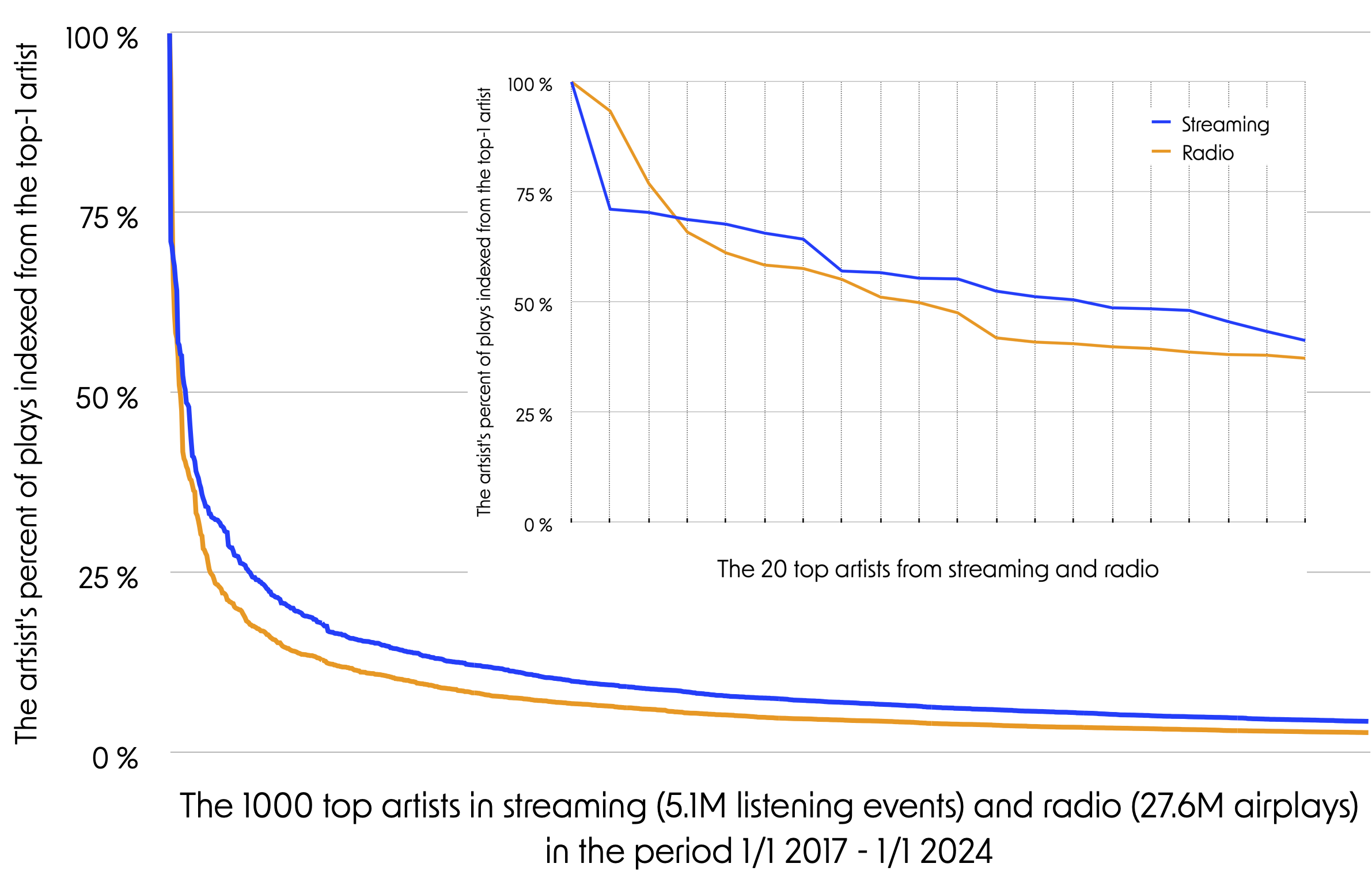
The two plots show the distribution of airplay and listening events for the Top-1,000 and Top-20 artists. This means that the number of plays of each of the artists in the top 1,000 or top 20 is compared to that of the first artist.

The orange line that represents artists being played in the radio takes a more sudden "dive" than the blue line that represents the streaming artists. This suggests that the radio's less popular artists receive less play time compared to streaming data. In other words, our donors listen to a broader range of top artists. The inserted graph shows details for the Top-20 artists.

Details

The percentage for each artist has been calculated by dividing the number of airplays / listening events for the artist by the Top-1 artist for the period 1/1 2017 to 31/12 2024. We should note that the composition and ranking of top artists is different for streaming and radio playlists, respectively. We should also critically consider the comparability between the two datasets, the listening history and the playlist data: they cover different countries and different timespans.
The Exposure of Top Artists in Radio and Streaming

Streaming Allows for More Top Artists Than Radio Channels

Top Artists Exposure Comparison Plot

The two plots show the distribution of airplay and listening events for the Top-1,000 and Top-20 artists. This means that the number of plays of each of the artists in the top 1,000 or top 20 is compared to that of the first artist.

The orange line that represents artists being played in the radio takes a more sudden "dive" than the blue line that represents the streaming artists. This suggests that the radio's less popular artists receive less play time compared to streaming data. In other words, our donors listen to a broader range of top artists. The inserted graph shows details for the Top-20 artists.

Details

The percentage for each artist has been calculated by dividing the number of airplays / listening events for the artist by the Top-1 artist for the period 1/1 2017 to 31/12 2024. We should note that the composition and ranking of top artists is different for streaming and radio playlists, respectively. We should also critically consider the comparability between the two datasets, the listening history and the playlist data: they cover different countries and different timespans.

Label Dominance

Label Dominance Plot

Which Labels Dominate the Streaming?

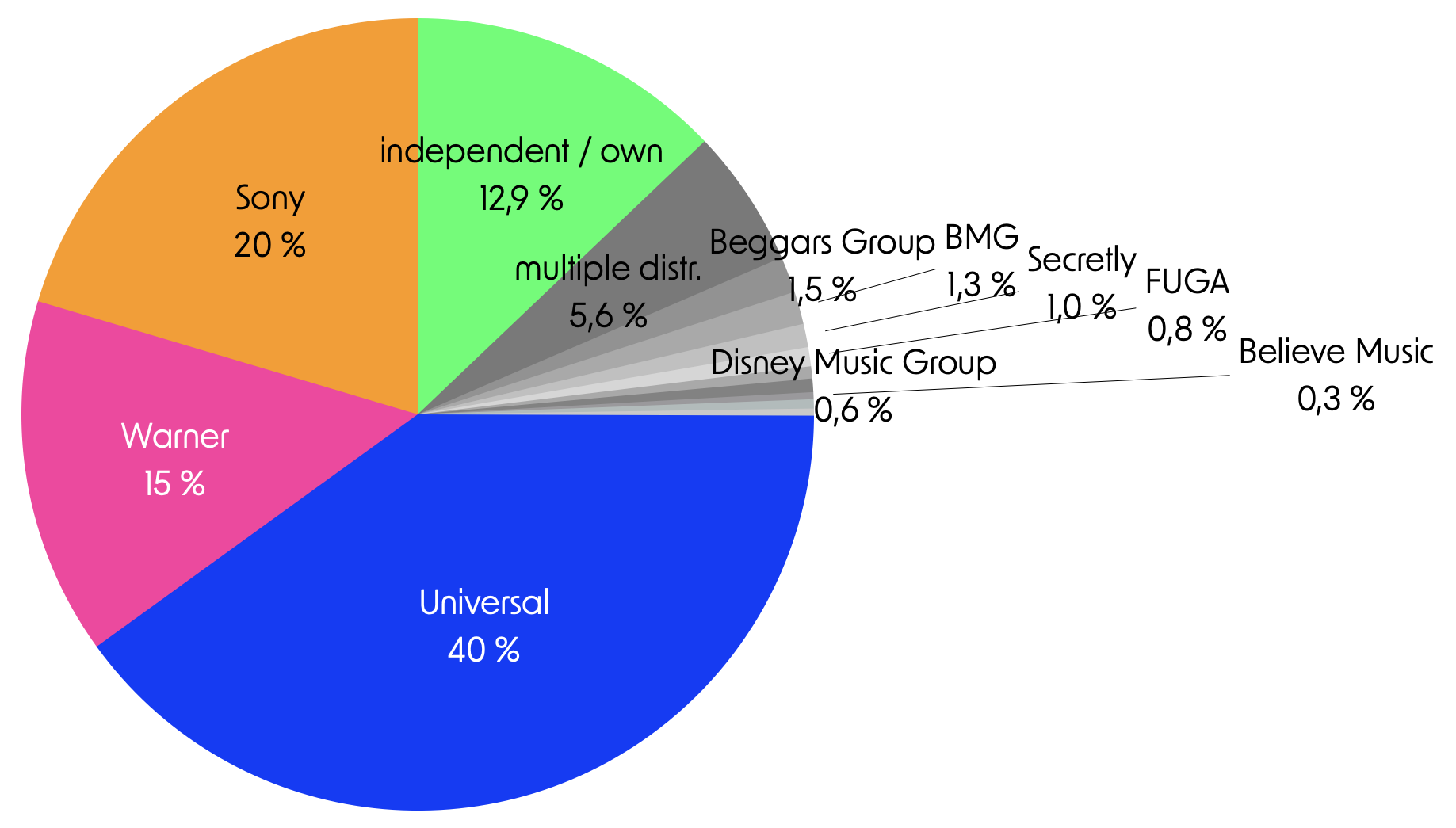
Among the top-100 labels, the three major labels (Universal, Warner and Sony) have a large share of our donors' streaming. "Self-released" and independent labels have however 12,9 % of all listening events.

The question is interesting as big labels may have a better position in negotiating exposure in streaming services' algorithmic recommendations than smaller, independent labels.

Identifying who has control over distribution is, however, difficult. Many small labels are owned by one of the big three or are dependent on their distribution. Among the top-100 labels, Universal controls 34 labels, Sony 10 and Warner 11.

Details

For the top-100 labels we have manually looked up the parent company or distributor. In case of mixed ownership and / or several distribution channels, we have used the category 'multiple'. Counted as smaller labels are: Redeye Distribution, RED Distribution, Believe Music, Secretly and FUGA.

We have examined the top-100 labels, but our donors listen to music from more than 10000 labels. The labels for which we have not examined ownership stand for around 66% of the listening. A more precise calculation of label dominance should include these many labels that may belong to one of the big three labels.

A sum of 2,76% of all the streaming listening can be attributed to 135 of 2352 labels that are members of IMPALA, a non-profit supporting smaller music companies and artists.
Label Dominance

Which Labels Dominate the Streaming?

Label Dominance Plot

Among the top-100 labels, the three major labels (Universal, Warner and Sony) have a large share of our donors' streaming. "Self-released" and independent labels have however 12,9 % of all listening events.

The question is interesting as big labels may have a better position in negotiating exposure in streaming services' algorithmic recommendations than smaller, independent labels.

Identifying who has control over distribution is, however, difficult. Many small labels are owned by one of the big three or are dependent on their distribution. Among the top-100 labels, Universal controls 34 labels, Sony 10 and Warner 11.

Details

For the top-100 labels we have manually looked up the parent company or distributor. In case of mixed ownership and / or several distribution channels, we have used the category 'multiple'. Counted as smaller labels are: Redeye Distribution, RED Distribution, Believe Music, Secretly and FUGA.

We have examined the top-100 labels, but our donors listen to music from more than 10000 labels. The labels for which we have not examined ownership stand for around 66% of the listening. A more precise calculation of label dominance should include these many labels that may belong to one of the big three labels.

A sum of 2,76% of all the streaming listening can be attributed to 135 of 2352 labels that are members of IMPALA, a non-profit supporting smaller music companies and artists.

Eleven Reasons to Start

11 Reasons to Start Streaming Plot

Over 14 Years the Share of Algorithmic Autoplay Grows

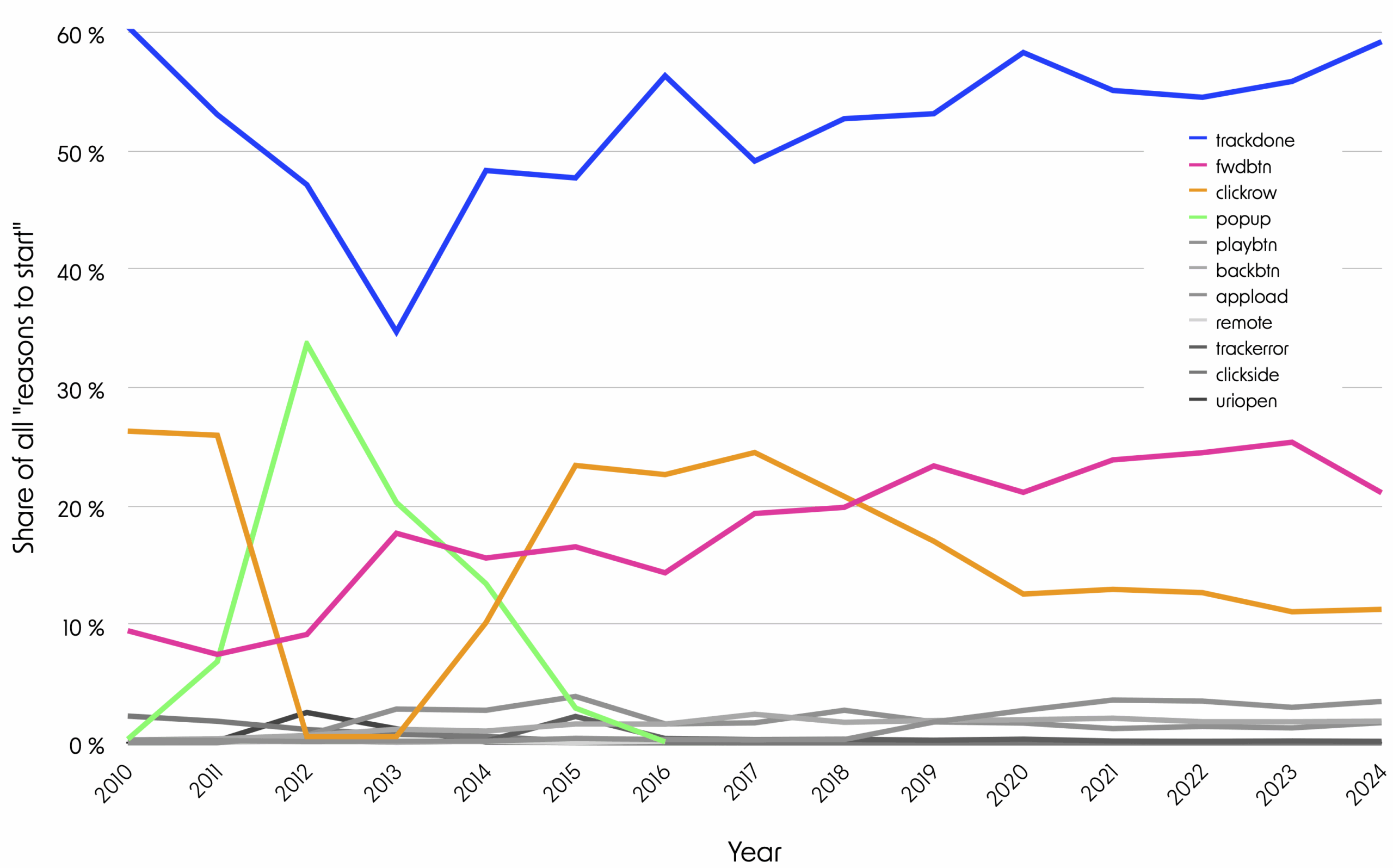
Spotify's data includes the category: "reason to start". This enables us to examine whether a track was actively chosen by a user or played automatically. Over the last 10 years, the share of "trackdone" (auto-play) has grown while the share of "clickrow" (active choice) has declined. Increasingly, also "fwdbtn" (the "Forward" button) is being pressed, indicating dissatisfaction with the auto-play. Since "trackdone" accounts for the majority of listening events, we conclude that most listening is passive.

Details

In the early years, "pop-up" was a dominant "reason to Start". It has not been possible for us determine with certainty what "pop-up" implies. Internet sources speculate that it was a marketing feature, suggesting tracks to users.

This graph is based only on Spotify data; each song in the streaming history is labeled with one of eleven reasons for starting. All eleven reasons for a track starting are displayed on the graph based on their proportion each year. The four main reasons: "trackdone", "fwdbtn", "clickrow", and "popup" are highlighted. Reasons to start which require the user to interact with the platform, such as "fwdbtn" or "clickrow", are considered as active. Automatic playing of a queue, album, playlist, etc., as indicated by "trackdone", is considered as passive. In addition to "trackdone" being the most dominant, a large share of passivity on streaming platform algorithms is perceived by users, as explored in the section "Views on the Role of Platform-Curated Playlists in Music Streaming".
Eleven Reasons to Start

Over 14 Years the Share of Algorithmic Autoplay Grows

11 Reasons to Start Streaming Plot

Spotify's data includes the category: "reason to start". This enables us to examine whether a track was actively chosen by a user or played automatically. Over the last 10 years, the share of "trackdone" (auto-play) has grown while the share of "clickrow" (active choice) has declined. Increasingly, also "fwdbtn" (the "Forward" button) is being pressed, indicating dissatisfaction with the auto-play. Since "trackdone" accounts for the majority of listening events, we conclude that most listening is passive.

Details

In the early years, "pop-up" was a dominant "reason to Start". It has not been possible for us determine with certainty what "pop-up" implies. Internet sources speculate that it was a marketing feature, suggesting tracks to users.

This graph is based only on Spotify data; each song in the streaming history is labeled with one of eleven reasons for starting. All eleven reasons for a track starting are displayed on the graph based on their proportion each year. The four main reasons: "trackdone", "fwdbtn", "clickrow", and "popup" are highlighted. Reasons to start which require the user to interact with the platform, such as "fwdbtn" or "clickrow", are considered as active. Automatic playing of a queue, album, playlist, etc., as indicated by "trackdone", is considered as passive. In addition to "trackdone" being the most dominant, a large share of passivity on streaming platform algorithms is perceived by users, as explored in the section "Views on the Role of Platform-Curated Playlists in Music Streaming".

Views on Fairness

Views on Fairness

Music Professionals View on Fairness

A Europe-wide Survey

Fair MusE researchers conducted an online survey conducted among music professionals and music business experts across Europe to learn about their views on fairness in the music eco-system.

A survey in six languages (English, French, German, Italian, Greek, and Spanish) was distributed to 3400 recipients randomly selected from open-access databases. A total of 360 respondents answered. The sample is representative in terms of gender, age, and professional role, and it represents more than 19 European nationalities, thus contributing to a broad and diverse dataset.

The findings should, however, not be used without proper contextualisation. We therefore strongly recommend consulting the full results and analysis provided in the Fair MusE Deliverable D3.2.

Details

The survey was also disseminated with the assistance of representatives of music industry associations, such as the European Grouping of Societies of Authors and Composers (GESAC), the Association of European Performers’ Organisations (AEPO-ARTIS), the European Music Council, and the Independent Music Companies Association IMPALA. A total of 360 respondents completed all of the attitude-, sociodemographic-, geographic-, and professional-related questions and their answers were included in the final dataset for multivariate analysis.

Music Professionals View on Fairness

A Europe-wide Survey

Fair MusE researchers conducted an online survey conducted among music professionals and music business experts across Europe to learn about their views on fairness in the music eco-system.

A survey in six languages was distributed to 3400 recipients. A total of 360 respondents answered. The sample is representative in terms of gender, age, and professional role.

The findings should, however, not be used without proper contextualisation. We therefore strongly recommend consulting the full results in Deliverable D3.2.

Details

The survey was also disseminated with the assistance of representatives of music industry associations (GESAC, AEPO-ARTIS, EMC, IMPALA). A total of 360 respondents completed all questions and were included in the final dataset.

Views on the Role of Platform-Curated Playlists in Music Streaming

Views on platform-curated playlists

Play Your Own Tune - Views on Passive Listening and Automatic Recommendations

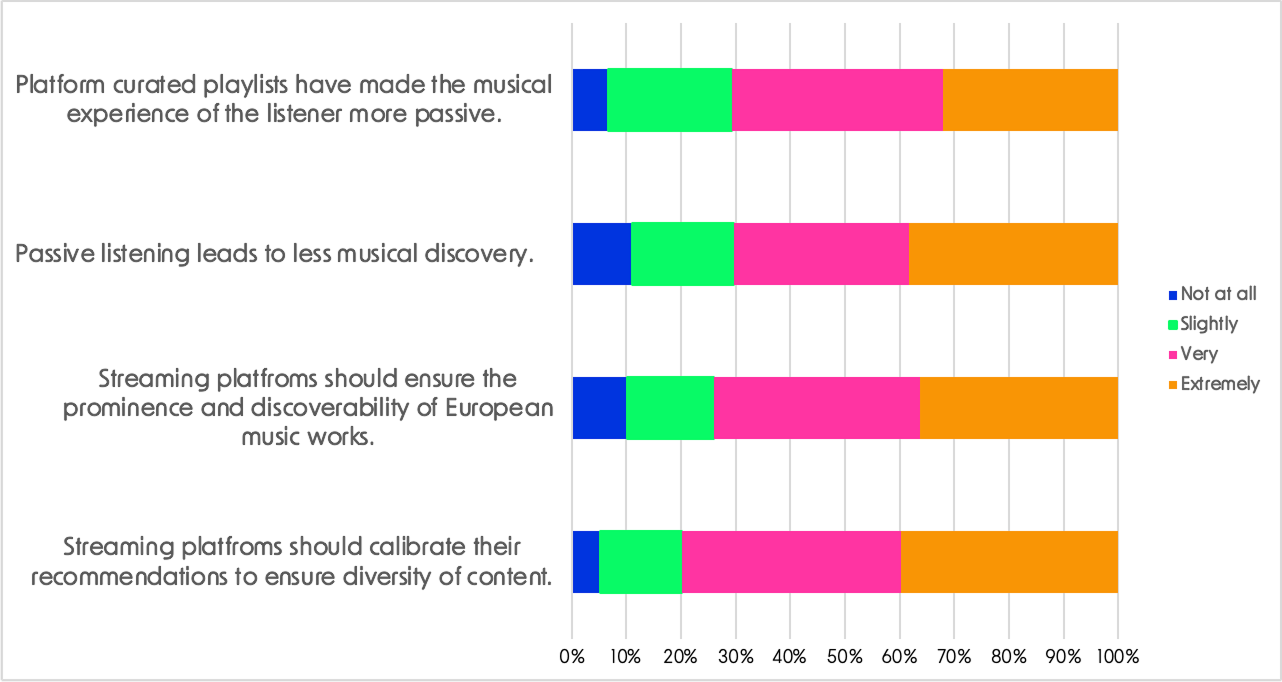
Current platform-curated playlists and recommendations act as a barrier to music discovery and lead to more passive and less diverse listening. This statement is a summary of the majority view on the four statements presented in the graph, reflecting a lack of trust in autonomous decision making and a desire for external implementation of streaming diversity.

Details

Over 2/3 of respondents consistently agreed "extremely" or "very" with the four statements on passive listening. This high level of agreement reached almost 80% for the statement suggesting that platforms should calibrate their recommendations to ensure diversity of content. For more information, please refer to the Deliverable D3.2.
Views on the Role of Platform-Curated Playlists in Music Streaming

Play Your Own Tune - Views on Passive Listening and Automatic Recommendations

Views on platform-curated playlists

Current platform-curated playlists and recommendations act as a barrier to music discovery and lead to more passive and less diverse listening. This statement is a summary of the majority view on the four statements presented in the graph, reflecting a lack of trust in autonomous decision making and a desire for external implementation of streaming diversity.

Details

Over 2/3 of respondents consistently agreed "extremely" or "very" with the four statements on passive listening. This high level of agreement reached almost 80% for the statement suggesting that platforms should calibrate their recommendations to ensure diversity of content. For more information, please refer to the Deliverable D3.2.
Key Terms Associated with Fairness

Key terms associated with fairness in the music industry

An EU-Wide Survey Among Music Creators

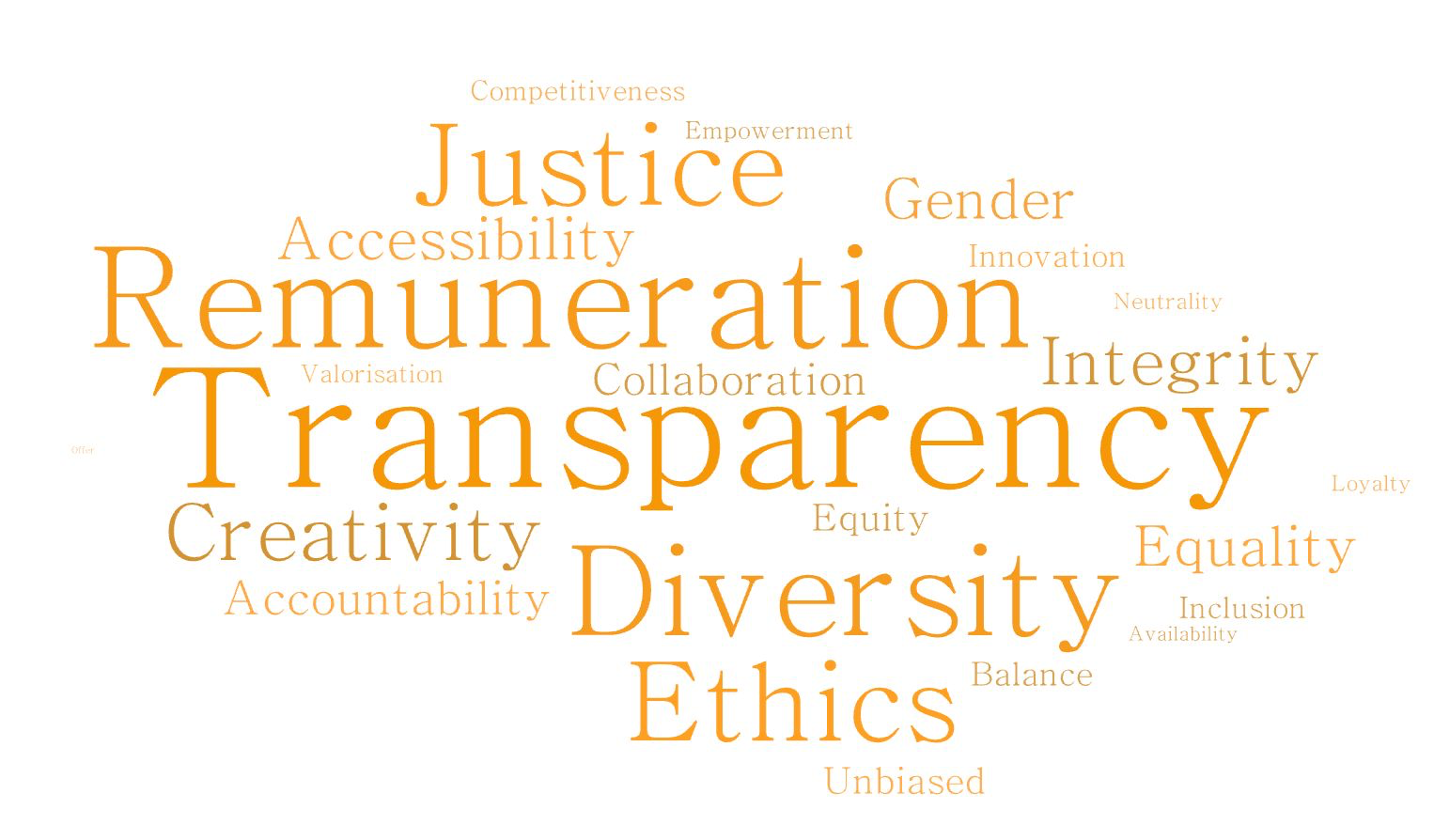
Respondents were asked which terms they associate with fairness in the music industry. 353 respondents selected up to three terms from a list of 23 options. Highlighted in the wordcloud, the terms transparency (58.9%), remuneration (52.7%), and diversity (45.6%) were the most prominent answers.

Details

For more information, please refer to the Deliverable D3.2.
Key Terms Associated with Fairness

An EU-Wide Survey Among Music Creators

Key terms associated with fairness

Respondents were asked which terms they associate with fairness in the music industry. 353 respondents selected up to three terms from a list of 23 options. Highlighted in the wordcloud, the terms transparency (58.9%), remuneration (52.7%), and diversity (45.6%) were the most prominent answers.

Details

For more information, please refer to the Deliverable D3.2.

Is Transparency Present and Can It Contribute to Fairness?

Algorithm transparency and fairness

Putting Recommender Systems in the Spotlight

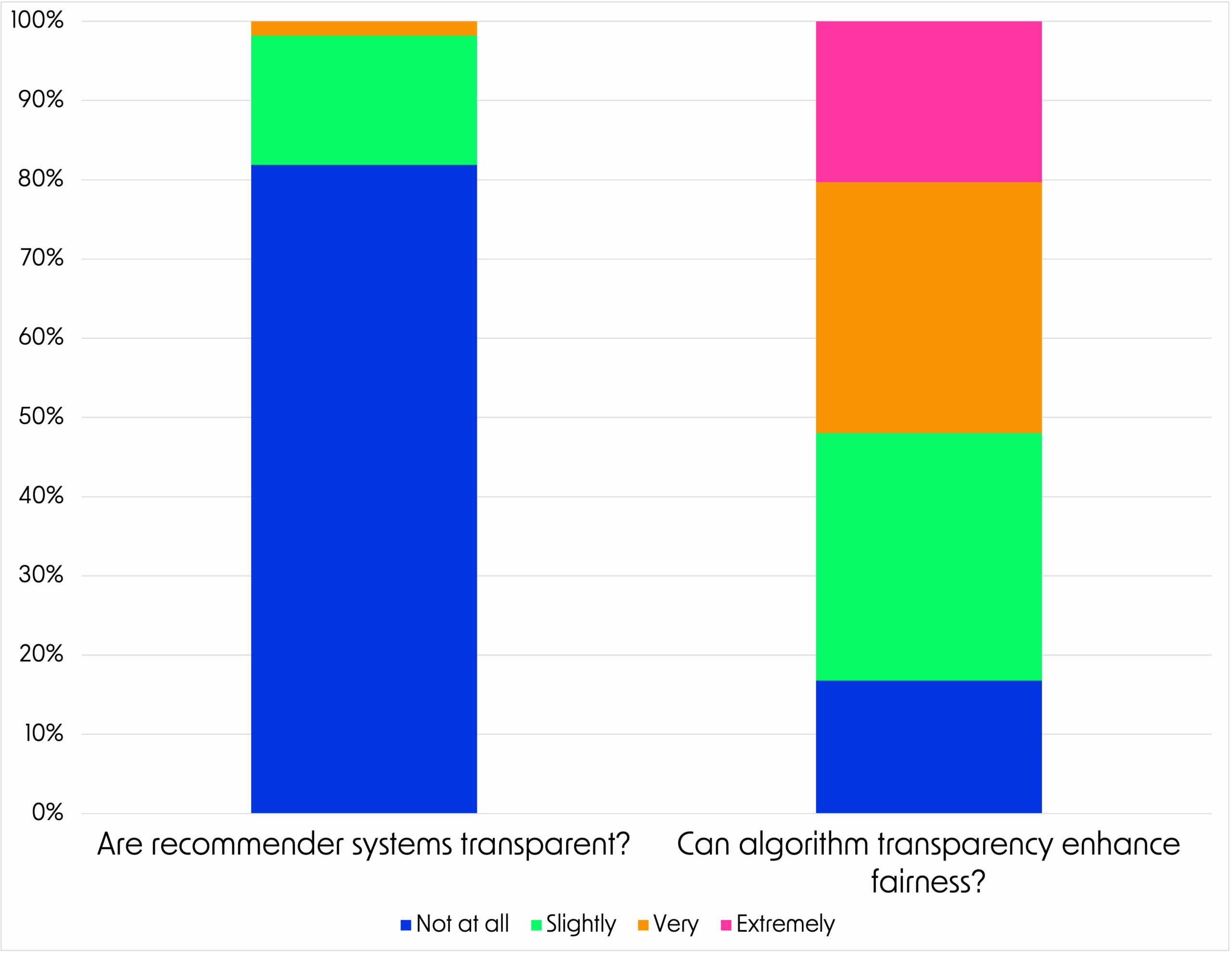
The survey results underscore significant concerns about the lack of transparency. A striking 98.2% of respondents perceived recommender systems as ‘not transparent at all’ or ‘slightly transparent’, with only a negligible 1.8% considering them ‘very transparent’. The potential for greater transparency to improve fairness elicited mixed reactions among respondents. While 31% believed that better access to data about recommender systems could ‘slightly’ or improve fairness ‘very’ much, 20% were more optimistic, choosing ‘extremely’, while 17% felt it would make no difference (‘not at all’).

Details

For more information, please refer to the Deliverable D3.2.

Is Transparency Present and Can It Contribute to Fairness?

Putting Recommender Systems in the Spotlight

Algorithm transparency and fairness

The survey results underscore significant concerns about the lack of transparency. A striking 98.2% of respondents perceived recommender systems as ‘not transparent at all’ or ‘slightly transparent’, with only a negligible 1.8% considering them ‘very transparent’.

The potential for greater transparency to improve fairness elicited mixed reactions among respondents. While 31% believed that better access to data about recommender systems could ‘slightly’ or improve fairness ‘very’ much, 20% were more optimistic, choosing ‘extremely’, while 17% felt it would make no difference (‘not at all’).

Details

For more information, please refer to the Deliverable D3.2.

How to Create a More Fair Artist Remuneration?

Criteria for fair artist remuneration

Which Criteria are Deemed Fairest for Inclusion in Streaming Payment Systems?

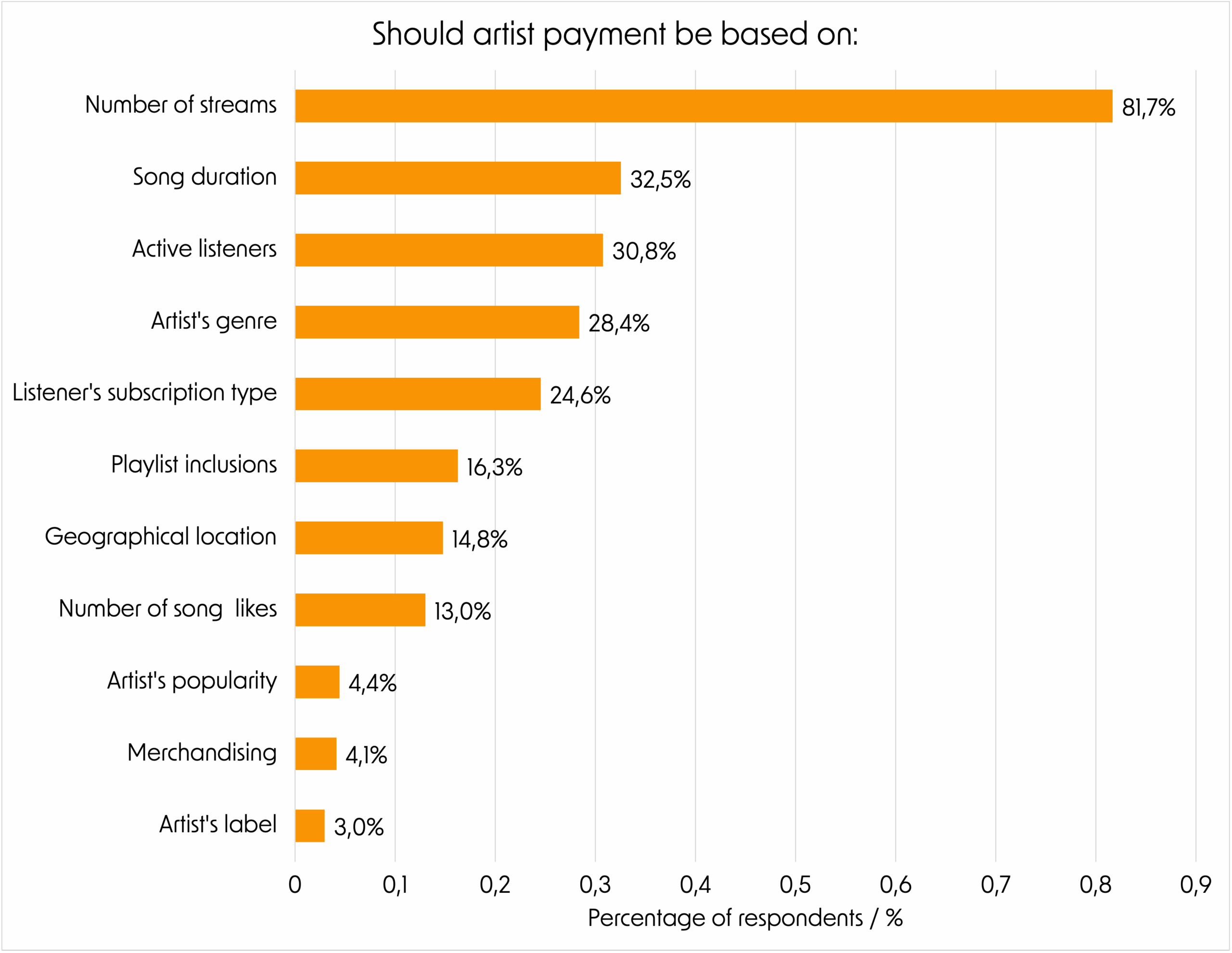
The majority (81.7%) of respondents in the survey favoured a payment model based on the song’s number of streams, indicating a preference for a system where "the more streams a song gets, the higher the payment". Interestingly, the second most selected option was payment relative to the song’s duration, with 32.5% favouring longer songs receiving higher compensation. This suggests dissatisfaction with the current remuneration model, where payments are triggered after just 30 seconds of play, disproportionately impacting genres like jazz and classical music that often feature longer tracks.

Details

Multiple answers could be selected by respondents. Refer to Deliverable D3.2 for details.
How to Create a More Fair Artist Remuneration?

Which Criteria are Deemed Fairest for Inclusion in Streaming Payment Systems?

Criteria for fair artist remuneration

The majority (81.7%) of respondents in the survey favoured a payment model based on the song’s number of streams, indicating a preference for a system where "the more streams a song gets, the higher the payment".

Interestingly, the second most selected option was payment relative to the song’s duration, with 32.5% favouring longer songs receiving higher compensation. This suggests dissatisfaction with the current remuneration model, where payments are triggered after just 30 seconds of play, disproportionately impacting genres like jazz and classical music that often feature longer tracks.

Details

Multiple answers could be selected by respondents. Refer to Deliverable D3.2 for details.

View on EU Regulations

Views on EU regulations and algorithm governance

A Call for EU Involvement

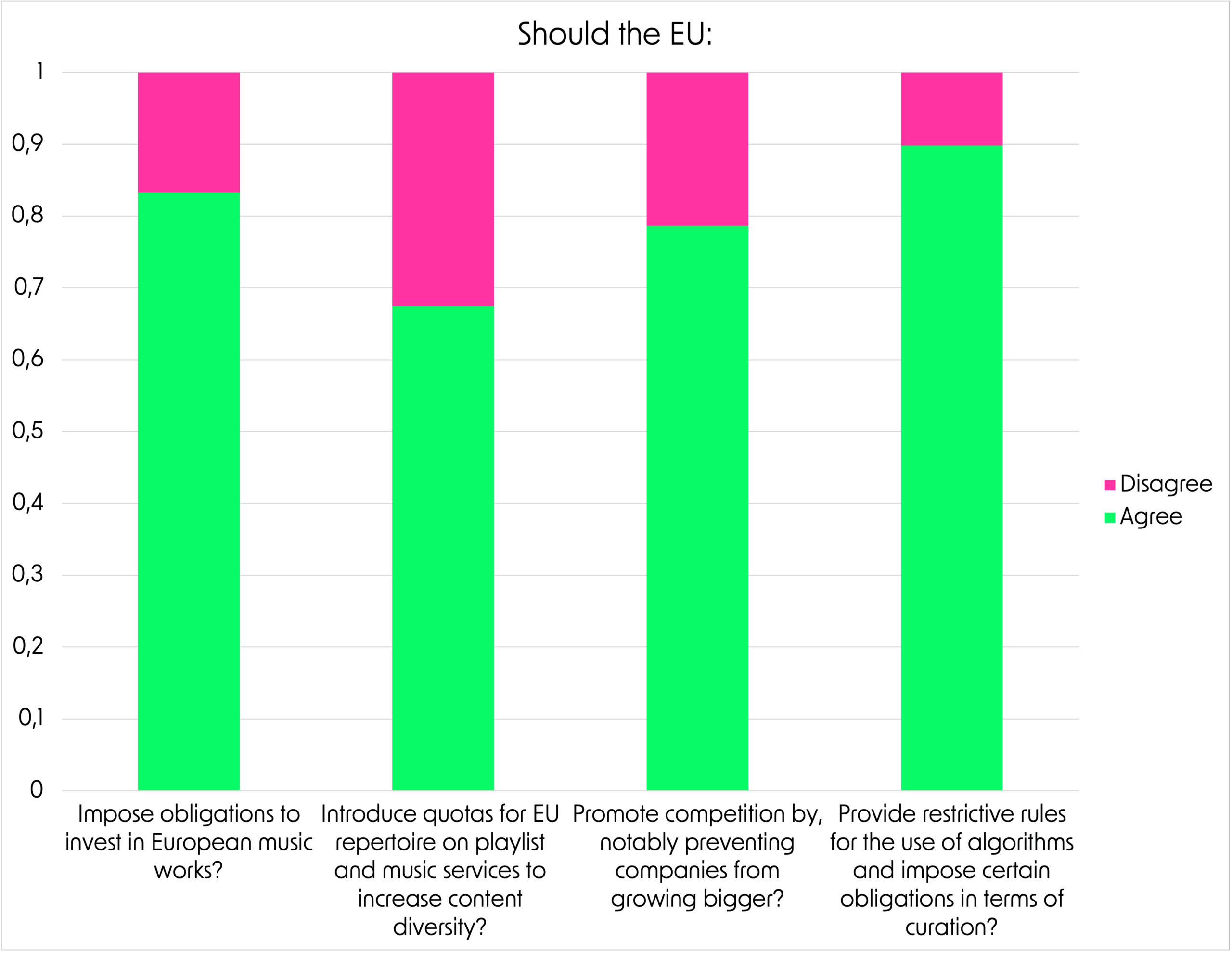
The majority of responses indicate that, across all categories, greater EU involvement and proactivity would be welcome. Nearly 90% of respondents agree that the EU should impose restrictions on music recommender algorithms, suggesting a sense of inadequacy or mistrust in the current system.

Details

For more information, please refer to the Deliverable D3.2.
View on EU Regulations

A Call for EU Involvement

Views on EU regulations and algorithm governance

The majority of responses indicate that, across all categories, greater EU involvement and proactivity would be welcome. Nearly 90% of respondents agree that the EU should impose restrictions on music recommender algorithms, suggesting a sense of inadequacy or mistrust in the current system.

Details

For more information, please refer to the Deliverable D3.2.

EU Policies on the Music Sector

EU policies on the music sector timeline

Focus Changes Over Time

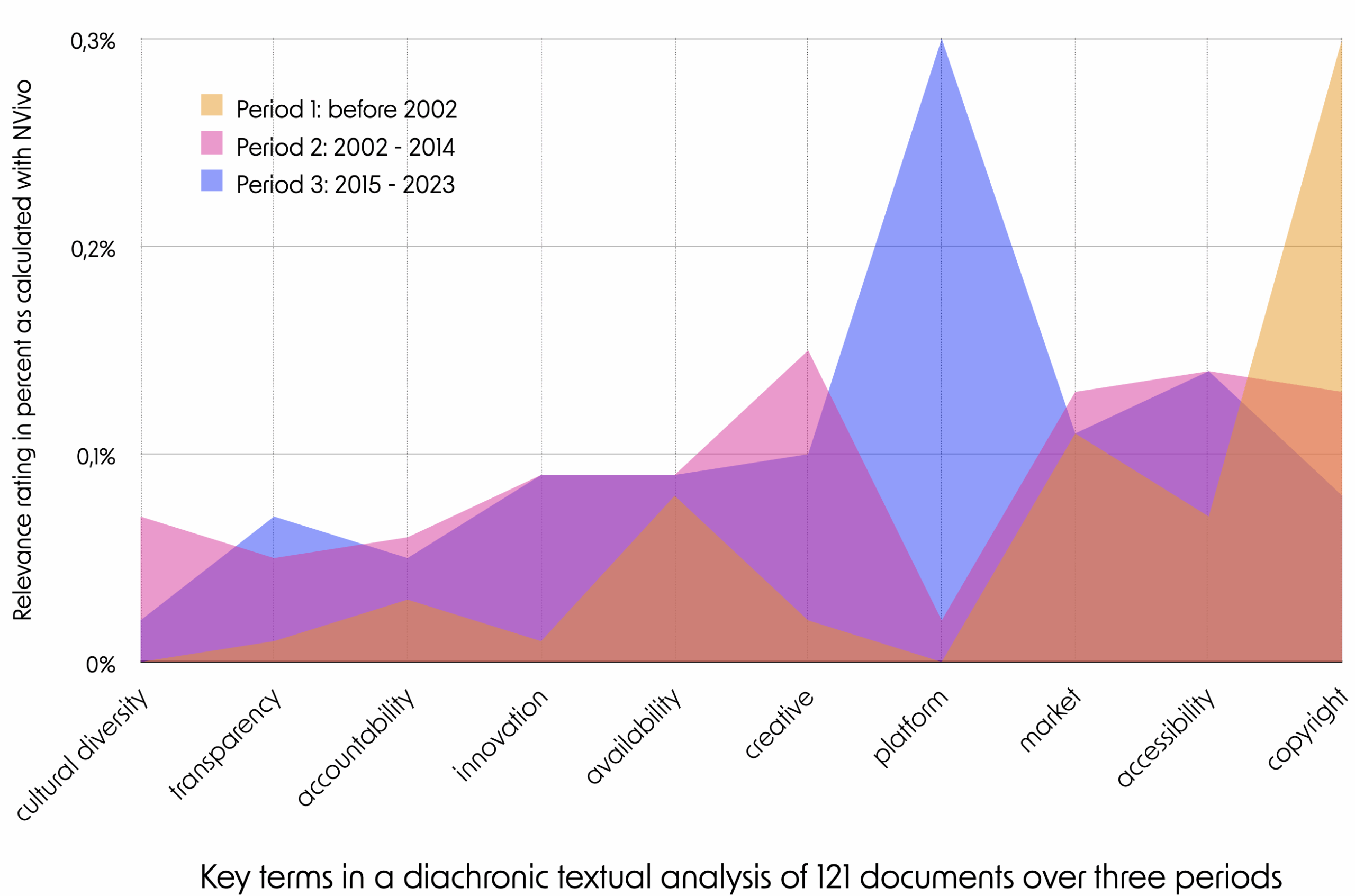
In the early 2000s, copyright was frequently framed as an issue of fairness in the music industry's EU legislative documentation, reflecting its relevance in an increasingly digitalized environment. Between 2002 and 2015, several new key terms gained prominence, including a growing emphasis on creativity and innovation, alongside the emergence of new themes such as platforms and cultural diversity. From 2015 to the present, platforms have become increasingly central to EU policy discussions, as has their popularity as a means through which music is accessed, consumed, and discovered.

Details

We visualise an in-depth diachronic textual analysis of the EU institutions’ legislative acts and policy instruments related to EU policy on the music sector since the early 1990s. The analysis carried out is based on 121 documents issued by the European Commission (the Commission), the European Parliament, the Council of the European Union (the Council), as well as the European Parliament and the Council as co-legislators. NVivo is used as a tool to quantitatively map the occurrences of specific keywords in the documents (Hilal and Alabri 2013). The results are subsequently presented in terms of a relevance rating generated by NVivo and expressed as percentages. In all, 162 relevant keywords were chosen to break the text materials into small chunks of information; targeted textual research was then conducted across the entire dataset, resulting in each keyword being assigned numerical data. These findings should not be used without appropriate contextualisation. We therefore strongly recommend consulting the full results and conclusions in the Fair MusE report D2.1.

EU Policies on the Music Sector

Focus Changes Over Time

EU policies on the music sector timeline

In the early 2000s, copyright was frequently framed as an issue of fairness in the music industry's EU legislative documentation, reflecting its relevance in an increasingly digitalized environment.

Between 2002 and 2015, several new key terms gained prominence, including a growing emphasis on creativity and innovation, alongside the emergence of new themes such as platforms and cultural diversity. From 2015 to the present, platforms have become increasingly central to EU policy discussions, as has their popularity as a means through which music is accessed, consumed, and discovered.

Details

We visualise an in-depth diachronic textual analysis of the EU institutions’ legislative acts and policy instruments related to EU policy on the music sector since the early 1990s. The analysis carried out is based on 121 documents issued by the European Commission (the Commission), the European Parliament, the Council of the European Union (the Council), as well as the European Parliament and the Council as co-legislators.

NVivo is used as a tool to quantitatively map the occurrences of specific keywords in the documents (Hilal and Alabri 2013). The results are subsequently presented in terms of a relevance rating generated by NVivo and expressed as percentages. In all, 162 relevant keywords were chosen to break the text materials into small chunks of information; targeted textual research was then conducted across the entire dataset, resulting in each keyword being assigned numerical data.

These findings should not be used without appropriate contextualisation. We therefore strongly recommend consulting the full results and conclusions in the Fair MusE report D2.1.

What Do Streaming Users Think About Fairness?

Selected Quotes

Semi-structured interviews were carried out with streaming platform users all over Europe. Here are some opinions they had about what fairness means in the music industry:

“Because in fact, who makes the content, who produces value, are the artists... I think it would be normal to support in any case, to give more channels to these artists.”

“I think that for artists it's important that their music is well protected... Especially, there are many artists who have very good beats and what people do is copy their beats.”

“I think if we picture this business as a cake, I think fairness would be the one who makes the cake would get the biggest part of the actual cake.”

“There is a much bigger diversity... But it also has the consequence that fewer musicians can make a living off of it.”

Details

During 2024, we conducted 36 in-depth semi-structured interviews with regular streaming platform users, encompassing a diverse range of European countries, although the majority were from either France, Denmark or Portugal. To begin with, users were queried about their listening habits and streaming service use, especially their experience with the recommendation systems. Then, the concept of fairness and their perception of it within the streaming platforms was explored. Do they consider the current services as fair? Are music streaming services supposed to be fair? Is fairness important from a user perspective, and if so, what elements of fairness do they emphasize?

What Do Streaming Users Think About Fairness?

Selected Quotes

Semi-structured interviews were carried out with streaming platform users all over Europe. Here are some opinions they had about what fairness means in the music industry:

“Because in fact, who makes the content, who produces value, are the artists... I think it would be normal to support in any case, to give more channels to these artists.”

“I think that for artists it's important that their music is well protected... Especially, there are many artists who have very good beats and what people do is copy their beats.”

“I think if we picture this business as a cake, I think fairness would be the one who makes the cake would get the biggest part of the actual cake.”

“There is a much bigger diversity... But it also has the consequence that fewer musicians can make a living off of it.”

Details

During 2024, we conducted 36 in-depth semi-structured interviews with regular streaming platform users, encompassing a diverse range of European countries, although the majority were from either France, Denmark or Portugal. To begin with, users were queried about their listening habits and streaming service use, especially their experience with the recommendation systems. Then, the concept of fairness and their perception of it within the streaming platforms was explored. Do they consider the current services as fair? Are music streaming services supposed to be fair? Is fairness important from a user perspective, and if so, what elements of fairness do they emphasize?

What Do Streaming Users Think About Fairness?

Selected Quotes

Semi-structured interviews were carried out with streaming platform users all over Europe. Here are some opinions they had about what fairness means in the music industry:

“Because in fact, who makes the content, who produces value, are the artists... I think it would be normal to support in any case, to give more channels to these artists.”

“I think that for artists it's important that their music is well protected... Especially, there are many artists who have very good beats and what people do is copy their beats.”

“I think if we picture this business as a cake, I think fairness would be the one who makes the cake would get the biggest part of the actual cake.”

“There is a much bigger diversity... But it also has the consequence that fewer musicians can make a living off of it.”

Details

During 2024 we conducted 36 in-depth semi-structured interviews with regular streaming platform users, encompasing a diverse range of European countries, although the majority were from either France, Denmark or Portugal. To begin with, users were queried about their listening habits and streaming service use, especially their experience with the recommendation systems. Then the concept of fairness and their perception of it within the streaming platforms was explored. Do they consider the current services as fair? Are music streaming services supposed to be fair? Is fairness important from a user perspective, and if so, what elements of fairness do they emphasize?

Other Music Data Sources

Aggregated Numbers From Lobby Organisations, Streaming Services and Statistical Authorities.

While raw data is difficult to access, various organisations present aggregated numbers published for different purposes.

Other Music Data Sources

Aggregated Numbers From Lobby Organisations, Streaming Services and Statistical Authorities.

While raw data is difficult to access, various organisations present aggregated numbers published for different purposes.

Credits

Visualisations: Daniel Bedoya, Laura Nosková and Jannick Kirk Sørensen
Editors: Jannick Kirk Sørensen & Heritiana Renaud Ranaivoson
Production: Laura Nosková
Web editor: Deborah Tewelde

Credits

Visualisations Daniel Bedoya, Laura Nosková and Jannick Kirk Sørensen
Editors Jannick Kirk Sørensen & Heritiana Renaud Ranaivoson
Production Laura Nosková
Web editor Deborah Tewelde